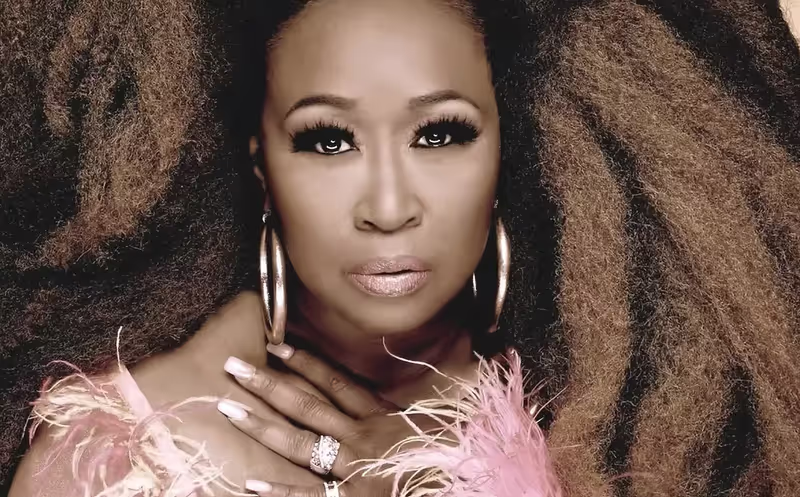
Terisa Griffin does not just sing a song. She lives inside it.
That truth came through clearly during her special WaveNation conversation for “Soul of a Woman,” a Women’s History Month celebration centered on voice, resilience, love and legacy. Sitting with Karesse Clemons, Griffin opened up about the roots that shaped her, the people who poured into her and the lessons she has learned while building a life in music without losing herself in the process.
Griffin, a proud daughter of Monroe, Louisiana, carries the South in her voice, her humor, her confidence and her spiritual grounding. She described Louisiana as a place where food and music are almost sacred — a rich blend of gospel, blues, jazz, R&B and cultural tradition. That heritage did more than influence her sound. It helped shape the woman she became.
“I take with me the pride of being a woman,” Griffin said, reflecting on lessons passed down from her father.
She spoke openly about being taught to embrace her body, honor her word and trust that God was carrying her, even in seasons when she felt alone.
Those lessons have followed Griffin from local stages to national television, including her appearance on “The Voice.” While some viewers may have expected her to measure the experience by whether she won the competition, Griffin sees it differently. For her, the show became a platform — one that introduced her to people who continue to recognize, support and celebrate her music years later.
“I did exactly what I should do,” she said. “I came home. I got married to the most amazing guy who really believed in my career.”
That love story became one of the emotional anchors of the conversation. Griffin spoke with deep gratitude about her husband’s support, especially as an independent artist navigating the realities of radio, promotion and visibility. His belief in her work helped push her music further and gave her more confidence to keep going.
Love also sits at the heart of her song “When You’re Around Me,” a record and video Griffin described as both romantic and visually daring. Shot in Chicago during brutally cold winter conditions, the video placed Griffin in a see-through dress on Michigan Avenue with snow, lights and freezing air surrounding her. She laughed while remembering the crew’s reaction, but she was clear about why she committed to the moment.
She wanted the visual to feel like Chicago. She wanted the winter. She wanted the elegance. She wanted the drama. And she wanted to show grown womanhood without apology.
Terisa Griffin on Indie Uncensored
Terisa Griffin on The Voice, Aretha Franklin, Love & Legacy | Indie Uncensored
The video also reflected the fullness of her audience. Griffin intentionally included friends and supporters from the LGBTQ+ community, honoring the people who have embraced her music, learned her songs and celebrated her artistry for years. For Griffin, love is not limited by gender, image or expectation. It is something that deserves to be seen honestly.
That honesty became one of the strongest themes of the interview. When asked what advice she would give to people struggling to find love, Griffin did not offer clichés. She offered self-awareness.
“Be honest with who you are,” she said.
She explained that pretending to be someone else may attract the wrong person, while authenticity gives love a real chance to last. Griffin also spoke about a season when she “dated herself” — taking herself out, cooking for herself, setting the table, learning her own standards and discovering what she truly wanted before inviting someone else into her life.
It was funny, real and deeply practical. It was also one of the clearest examples of Griffin’s ability to turn personal experience into wisdom.
Music, for Griffin, has always been tied to legacy. One of the most moving parts of the conversation came when she reflected on Aretha Franklin’s influence. Griffin recalled the power of hearing Franklin’s voice and seeing a Black woman, a preacher’s daughter and a Southern-rooted vocalist embrace every part of herself. Franklin gave Griffin permission to move beyond limitation and see gospel not as a box, but as a foundation.
Griffin also shared that she once arranged background vocals on one of Franklin’s later projects — a full-circle moment for an artist who had been deeply shaped by the Queen of Soul’s courage, command and freedom.
Her relationship to legacy extends beyond music. Griffin also reflected on the impact of Rev. Jesse Jackson and the importance of understanding artistry as part of a larger cultural responsibility. In the conversation, she connected music, faith and community, making clear that a singer’s voice can do more than entertain. It can affirm people. It can remind them who they are. It can carry memory, movement and meaning.
That sense of purpose has helped Griffin remain grounded as an independent artist. She understands the grind of releasing music without the full machinery of a major label. She knows what it means to fight for airplay, visibility and opportunity while still protecting the integrity of the work.
But Griffin does not speak about independence as a burden. She speaks about it as ownership.
Her career has been shaped by resilience, but also by discernment. She knows who she is. She knows what she carries. And she knows the difference between chasing attention and building something that lasts.
Throughout the interview, Griffin returned again and again to the importance of truth — truth in love, truth in music, truth in womanhood and truth in the way artists present themselves to the world. She spoke as someone who has survived enough seasons to know that talent alone is not the whole story. Character matters. Faith matters. Relationships matter. Self-knowledge matters.
That is what made the conversation feel less like a standard interview and more like a testimony.
Griffin was not simply promoting a song or revisiting a career highlight. She was naming the forces that made her: Louisiana roots, a father’s lessons, a husband’s belief, Aretha Franklin’s example, community support, spiritual conviction and the courage to keep showing up as herself.
For “Soul of a Woman,” that message landed with power.
Terisa Griffin is still singing from the soul because that is where her music begins. It is where her wisdom lives. It is where her story continues to grow.
And for every listener trying to love honestly, create boldly or stand fully in who they are, Griffin’s voice offers a reminder: the most powerful thing an artist can be is true.